
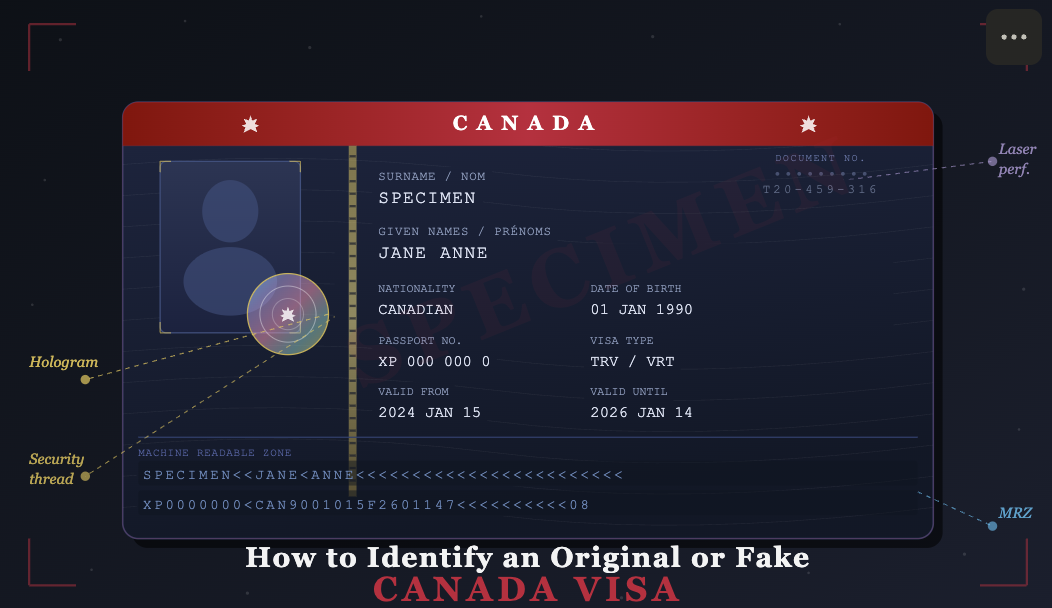
Canada remains one of the most sought-after destinations in the world for tourists, students, workers, and immigrants. With that demand comes a rising tide of document fraud. Knowing how to distinguish a genuine Canadian visa from a counterfeit one is no longer a skill reserved for border agents. It is knowledge every traveller, employer, landlord, and immigration consultant should carry.
This guide walks you through the specific security features of a legitimate Canada visa, the telltale signs of a forgery, and the official channels available to verify any document you encounter. Whether you have received a suspicious visa copy from an applicant, are verifying your own travel documents before departure, or simply want to protect yourself from fraud, the following information is essential reading.
Understanding the Canadian Visa System
Before diving into the visual and technical markers of authenticity, it helps to understand what type of document you are looking at. Canada issues several categories of visas and immigration documents, each with its own format. The most common are the Temporary Resident Visa (TRV), sometimes called the visitor visa, the Study Permit, the Work Permit, and the Electronic Travel Authorization (eTA). The eTA is a purely digital document linked to a passport and does not appear as a physical sticker or label at all.
Physical visas issued by Immigration, Refugees and Citizenship Canada (IRCC) are typically placed as a counterfoil sticker inside the passport. These stickers are produced to exacting government standards and incorporate a range of security features that are deliberately difficult to replicate.
Quick Note
If someone presents an eTA as a printed sticker or physical document, this is automatically fraudulent. The eTA exists only as a digital record in Canadian immigration databases and is tied to the passport number provided during the application.
Security Features of a Genuine Canada Visa
Genuine Canadian visas are produced using sophisticated printing and material technology. Familiarising yourself with these features is the first and most reliable step in spotting a fake.
Holographic Overlaminates
Authentic visas carry a holographic overlaminate layer bonded to the surface of the counterfoil. When you tilt the document under light, the hologram shifts colour and reveals embedded patterns, including the Canadian maple leaf and interlocking geometric designs. A counterfeit document may carry a flat, non-shifting sticker or a printed imitation of a hologram that does not respond to changes in angle or light.
Microprinting
Under magnification, genuine Canadian visas reveal lines of microprinting that are invisible to the naked eye. These tiny lines of text typically run along borders or within decorative elements and are nearly impossible to reproduce accurately on commercially available printers. If you examine a visa under a loupe and the fine text appears blurry, broken, or is absent altogether, that is a significant red flag.
Optically Variable Ink (OVI)
Certain elements on the genuine visa are printed with optically variable ink, which shifts between colours when viewed from different angles. This technology is used extensively on high-security documents worldwide. On an authentic Canadian visa, you will typically see a shift from gold to green or between similarly distinct colours when the document is tilted. A flat, non-changing ink finish in these areas indicates a possible forgery.
Laser-Perforated Document Number
Many genuine Canadian travel documents feature the document number perforated using laser technology through the material itself, rather than simply printed on the surface. When held up to light, these perforations are visible as a sequence of tiny holes forming numerals. This feature cannot be reproduced through standard printing methods.
UV-Reactive Elements
Under ultraviolet light, genuine Canadian visas reveal a series of hidden features, including background patterns, fibre traces embedded into the document material, and security inks that fluoresce in specific colours. Counterfeit documents often either show no reaction under UV light or produce a flat, uniform glow rather than the structured patterning of a genuine document.
- Holographic overlaminate with maple leaf and geometric patterns
- Microprinting along borders visible only under magnification
- Optically variable ink that shifts colour when tilted
- Laser-perforated document number readable when held to light
- UV-reactive inks and embedded security fibres
- Machine-readable zone (MRZ) at the bottom of the counterfoil
- Raised tactile printing in specific areas
- Guilloche background patterns with ultra-fine line precision
Reading the Machine-Readable Zone
Every genuine Canadian visa counterfoil contains a Machine-Readable Zone (MRZ) at the bottom of the document. This consists of two lines of characters in a standardised international format used by border control systems worldwide. The MRZ encodes critical data such as the document number, nationality, date of birth, expiry date, and check digits that validate the accuracy of each field.
When checking a visa, verify that the information visible in the MRZ matches what is printed in the human-readable fields above. Any discrepancy between the printed name, date of birth, or document number in the MRZ and the rest of the document is a strong indicator of tampering or outright forgery. Border scanners read the MRZ automatically, which is why fraudsters who alter documents visually often overlook the MRZ, leaving contradictory data.
A discrepancy between the printed fields and the machine-readable zone is one of the most common and detectable signs of document fraud. Always cross-reference every data point.
Comparing Genuine vs. Fraudulent Documents
The table below summarises the most practical visual differences between a genuine Canadian visa and a common forgery. Note that sophisticated forgeries may replicate several of these features superficially, which is why no single indicator should be treated as conclusive in isolation.
| Feature | Genuine Visa | Common Forgery |
|---|---|---|
| Hologram | Shifts and reflects; shows maple leaf in depth | Flat or printed; no light response |
| Microprinting | Clear, sharp text under magnification | Blurry, broken, or absent |
| Ink colour | Variable under angle (OVI present) | Static, no colour shift |
| UV response | Structured patterns and fibres visible | Uniform glow or no reaction |
| Paper/material | Polycarbonate or specialised substrate; feels distinct | Regular paper or plastic film; thin |
| MRZ consistency | Data matches all printed fields exactly | Discrepancies between MRZ and visible text |
| Perforations | Laser-precise holes forming document number | Absent or roughly punched holes |
| Photo integration | Laser-engraved; cannot be peeled or swapped | Glued, laminated separately, or digitally inserted |
Red Flags in Visa Applications and Copies
Not every instance of fraud involves a physical document. Many fraudulent visas are presented as digital copies, scanned images, or PDF files. When reviewing a visa copy rather than the original, the warning signs shift somewhat, and you need to apply a different level of scrutiny.
Poor Image Quality on Genuine Areas
A common method of visa fraud involves scanning a genuine visa and digitally altering the personal information using photo editing software. These alterations often leave traces: inconsistent fonts, slightly different pixel densities around edited text, misaligned characters, or uneven spacing. Examine every text field carefully, especially the name, date of birth, passport number, and visa validity dates.
Inconsistent Fonts or Spacing
Genuine Canadian visas are produced using specific government-standard typefaces. If the font in one area of the document appears different from the font in another area, this warrants further scrutiny. Spacing between characters or lines that appears irregular in certain fields, while consistent in others, is another indicator of digital tampering.
Missing or Incomplete Visa Numbers
Every Canadian visa carries a unique document number. If this number is absent, obscured, or appears to follow a non-standard format, the document may be fraudulent. The format of Canadian visa numbers follows specific patterns that immigration professionals and IRCC staff can verify instantly.
Never attempt to verify a visa by calling numbers or visiting websites not officially affiliated with IRCC or the Canadian government. Fraudulent “visa verification” services exist specifically to deceive individuals checking the authenticity of fake documents by confirming them as genuine.
06 Official Methods to Verify a Canadian Visa
The most reliable way to verify a Canadian visa is to use official government channels. IRCC provides several mechanisms for this purpose.
The IRCC Online Portal
Employers, educational institutions, and other authorised parties can use the IRCC web portal to verify certain types of immigration documents. The portal allows for checking the status of work permits and study permits by entering specific reference numbers. While not every document type is verifiable through the public portal, it covers many of the most commonly presented documents.
Contacting IRCC Directly
IRCC operates a client support centre that can assist with verification queries in appropriate circumstances. In cases where document fraud is suspected, IRCC should be notified as a matter of urgency. The Canada Border Services Agency (CBSA) also has a tip line for reporting suspected immigration fraud.
Working with a Regulated Canadian Immigration Consultant
Regulated Canadian Immigration Consultants (RCICs) and immigration lawyers have professional access to document verification resources and extensive practical experience with genuine documents. If you are an employer or institution regularly reviewing immigration documents, maintaining a relationship with an RCIC can provide both reassurance and legal protection.
- Use the IRCC secure account portal to check permit and visa status
- Contact IRCC directly via their official client support centre
- Report suspected fraud to the CBSA tip line
- Engage a Regulated Canadian Immigration Consultant for professional verification
- Request to examine the original physical document rather than a copy wherever possible
What to Do If You Suspect a Fake Visa
If you encounter a document you believe to be fraudulent, your response should be calm, methodical, and legal. Do not confront the individual in a way that could create a safety risk. Do not attempt to seize the document unless you have specific legal authority to do so.
In a professional context, such as an employer reviewing a work permit, you should decline to proceed with the engagement and document your concerns in writing. Report the suspected fraud to IRCC or the CBSA using official channels. Retain copies of any documentation you were provided, as this may assist investigators.
If you are an individual who has been given a fraudulent visa by an immigration consultant or third party as part of an application process, be aware that presenting a fake document to Canadian immigration authorities is a serious criminal offence under Canadian law, regardless of whether you were aware of the fraud. Seek urgent legal advice from a qualified immigration lawyer before travelling or presenting the document anywhere.
Ignorance is not always a complete legal defence in cases involving fraudulent immigration documents. If you have any doubt about the authenticity of a visa you have been given, seek professional legal advice before proceeding.
Document fraud is a growing global challenge, and Canada is not immune. The sophistication of forgeries has increased significantly with the availability of high-resolution scanning equipment and advanced image editing software. However, the security technology embedded in genuine government-issued documents has advanced in parallel, incorporating features that require industrial-grade machinery to replicate.
The practical lesson is straightforward: always prioritise examining the original physical document. Digital copies, no matter how clear, cannot reveal holographic features, UV responses, or tactile printing. Whenever possible, request that individuals present original travel documents in person, especially when the stakes are high.
Educating yourself and your colleagues on the features described in this guide is an investment that pays dividends in reduced legal risk, reputational protection, and the broader public good of keeping immigration systems honest. Canada’s visa security features exist for exactly this reason, and knowing them is the most reliable first line of defence against fraud.
Final Summary
Verify holograms under shifting light. Check microprinting under magnification. Confirm UV features with a basic ultraviolet torch. Cross-reference MRZ data against all visible fields. When in doubt, contact IRCC or a qualified immigration professional. These five steps will catch the vast majority of fraudulent Canadian visas before they cause serious harm.
This article is for informational purposes only. For official guidance, consult Immigration, Refugees and Citizenship Canada (IRCC) at canada.ca/immigration.
