
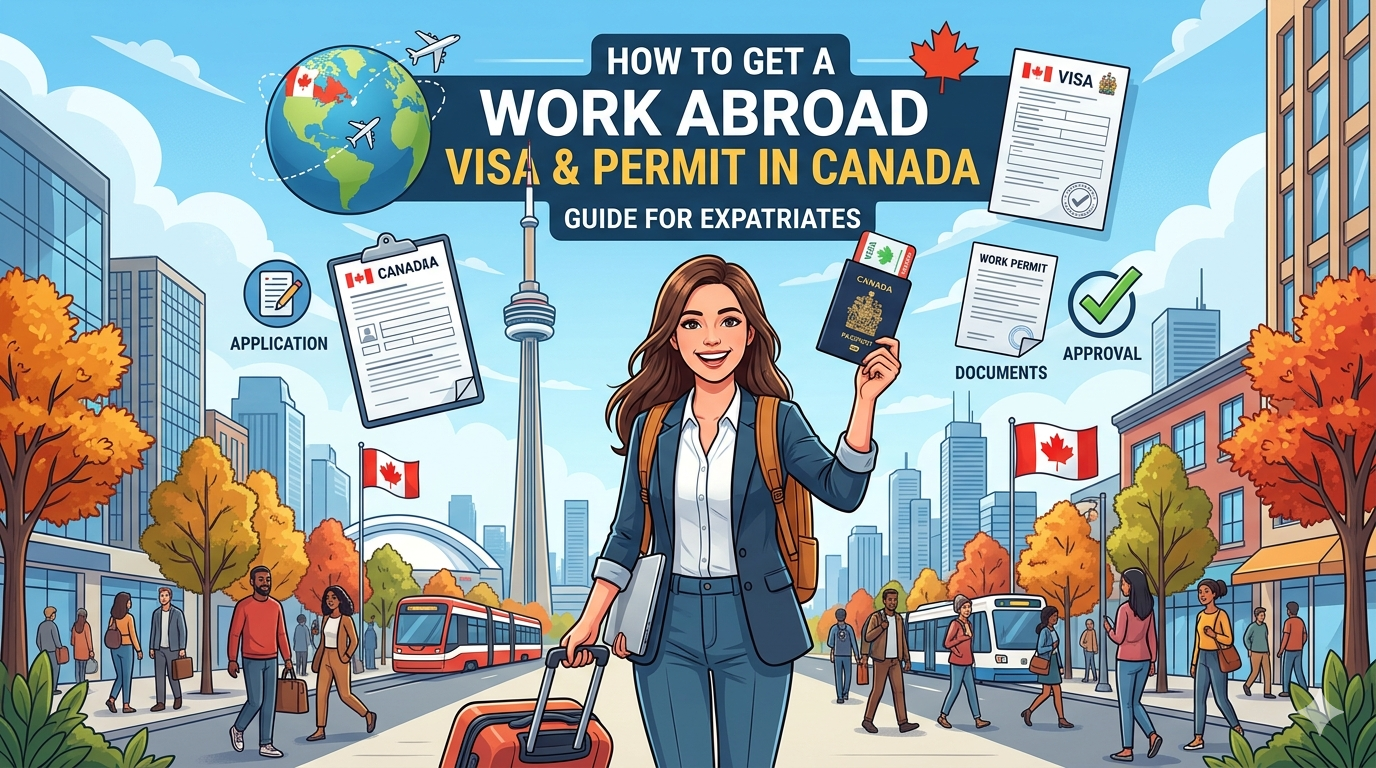
graduate looking for international experience, Canada’s immigration system offers several pathways to get you legally working on Canadian soil.
This guide walks you through everything you need to know about obtaining a Canadian work visa and work permit: the difference between the two, the main categories available, the step-by-step application process, and practical tips to improve your chances of approval.
Understanding the Difference: Work Visa vs. Work Permit
Before diving into the application process, it is important to understand a common point of confusion. In Canada, the terms “work visa” and “work permit” are sometimes used interchangeably, but they refer to different documents.
A work permit is the official document that authorizes you to work in Canada. It is issued by Immigration, Refugees and Citizenship Canada (IRCC) and specifies the conditions under which you are allowed to work, including which employer you can work for, the location, and the duration. Without a valid work permit, you cannot legally be employed in Canada as a foreign national.
A work visa (also called a Temporary Resident Visa or TRV) is a separate document that allows you to travel to and enter Canada. Not all nationalities need a TRV to enter Canada. Citizens of certain countries can enter with only an Electronic Travel Authorization (eTA), while others require a full visa stamped in their passport. In many cases, your work permit and travel authorization are processed together as part of the same application.
In short: the work permit lets you work; the travel visa lets you enter. Many applicants need both, and it is common to apply for them simultaneously through the IRCC online portal.
Types of Canadian Work Permits
Canada offers two broad categories of work permits: employer-specific and open work permits. Understanding which one applies to your situation is the first and most critical step in your application journey.
Employer-Specific (Closed) Work Permits
An employer-specific work permit, sometimes called a “closed” work permit, ties you to a particular employer. It will state the name of the employer, the job title, the location, and the period during which you are permitted to work. You cannot simply switch jobs while on this type of permit without first applying for and receiving a new work permit for the new employer.
Most employer-specific permits are issued under the Temporary Foreign Worker Program (TFWP), which requires your Canadian employer to obtain a Labour Market Impact Assessment (LMIA) from Employment and Social Development Canada (ESDC). The LMIA is a document that proves there is a genuine need for a foreign worker to fill the role and that no qualified Canadian citizen or permanent resident is available to do it.
Open Work Permits
An open work permit allows you to work for almost any employer in Canada without being tied to a specific job or company. This type of permit offers significantly more flexibility and is highly desirable. However, it is not available to everyone; you must meet specific eligibility criteria.
Some of the most common situations that qualify for an open work permit include: being an international student who has graduated from a Canadian designated learning institution (under the Post-Graduation Work Permit, or PGWP); being the spouse or common-law partner of a Canadian citizen, permanent resident, or skilled worker; or being a refugee claimant or protected person. The International Experience Canada (IEC) program, which offers Working Holiday visas, also issues open work permits to eligible young nationals from partner countries.
| Permit Type | Tied to Employer? | Requires LMIA? | Common Programs |
|---|---|---|---|
| Employer-Specific | Yes | Usually | TFWP, Intra-Company Transfer |
| Open Work Permit | No | No | PGWP, IEC (Working Holiday), Spousal |
Key Pathways to Working in Canada
There is no single route to obtaining a Canadian work permit. Your pathway will depend on your nationality, age, occupation, education, and whether you already have a job offer. Here are the primary programs most foreign workers use.
1. Temporary Foreign Worker Program (TFWP)
This is the most common pathway for skilled foreign workers who have a Canadian job offer. The employer initiates the process by applying for an LMIA, and once it is approved, you use it to support your work permit application. The TFWP covers roles across different skill levels, from high-wage positions to low-wage seasonal jobs in agriculture, food processing, and caregiving.
2. International Mobility Program (IMP)
The IMP allows certain foreign nationals to receive a work permit without an LMIA. This program covers intra-company transfers, workers under trade agreements such as the Canada-United States-Mexico Agreement (CUSMA, formerly NAFTA), and certain academic or cultural workers. Because no LMIA is required, the process is generally faster and less burdensome for employers.
3. International Experience Canada (IEC)
If you are between 18 and 35 years old and hold a passport from one of Canada’s partner countries, the IEC Working Holiday category is one of the best ways to live and work in Canada. It grants an open work permit for up to 24 months, depending on your nationality. Canada has IEC agreements with over 35 countries, including the United Kingdom, Australia, France, Germany, Japan, South Korea, and many others.
4. Post-Graduation Work Permit (PGWP)
International students who complete a program of at least eight months at a Canadian Designated Learning Institution (DLI) are eligible for a PGWP. The duration of the permit depends on the length of the study program, up to a maximum of three years. The PGWP is also an excellent stepping stone to permanent residency through programs like Canadian Experience Class under Express Entry.
Step-by-Step: How to Apply for a Canadian Work Permit
Step 1: Confirm Your Eligibility
Visit the official IRCC website (ircc.canada.ca) and use the “Come to Canada” wizard to determine which type of work permit you qualify for. You will need to know your nationality, current occupation, education level, and whether you have a Canadian job offer. Some nationalities may also face additional requirements, such as medical exams or police clearance certificates.
Step 2: Secure a Job Offer or LMIA (if required)
If you are applying under the TFWP, your Canadian employer must first obtain a positive LMIA from ESDC. This process can take several weeks to a few months. Once the LMIA is in hand, your employer will give you a copy along with a written job offer, which you will include in your work permit application. If you are applying under an LMIA-exempt category, you will instead need an offer of employment number, which the employer enters into the IRCC employer portal.
Step 3: Gather Your Required Documents
The exact list of documents depends on your situation, but most applicants will need: a valid passport with at least six months of validity beyond their intended stay; a copy of the LMIA or offer of employment number; proof of educational credentials and work experience; a completed application form (IMM 1295 for online applications); application fees (currently CAD 155 for a work permit, with additional fees if a TRV is also needed); and biometric enrollment if applicable (most applicants between 14 and 79 years of age will need this).
Depending on your country and the nature of your work, you may also need a medical exam completed by an IRCC-approved panel physician, and a police clearance certificate from every country you have lived in for six months or more since the age of 18.
Do not let your passport expire before your intended stay ends. IRCC will not issue a work permit that extends beyond your passport’s expiry date. If your passport is expiring soon, renew it before submitting your application.
Also, make sure all supporting documents submitted in a language other than English or French are accompanied by certified translations.
Step 4: Submit Your Application
Most applicants apply online through the IRCC secure account portal. You will create an account, complete the application forms, upload your documents, and pay the processing fee. After submitting, you will receive an acknowledgement of receipt (AOR), and your application will be assigned a unique file number that you can use to track its status online.
In some cases, such as for certain nationalities or specific permit categories, you may be required to apply at a Canadian visa application centre (VAC) in your home country. A small number of situations allow you to apply at the port of entry when you arrive in Canada, though this is increasingly uncommon and is not recommended for complex cases.
Step 5: Biometrics Enrollment
If prompted, you will need to visit a designated biometrics collection point to provide your fingerprints and photograph. After paying the biometrics fee (CAD 85 for individuals or CAD 170 for a family), you will receive a biometrics collection letter valid for 30 days. Biometrics are stored for 10 years, so if you have previously given them to IRCC, you may not need to do so again.
Step 6: Receive Your Approval and Travel
Processing times vary significantly depending on the permit category, your country of residence, and IRCC’s current workload. As of recent data, online work permit applications take anywhere from a few weeks to several months. Once approved, you will receive a Port of Entry (POE) letter of introduction (for overseas applicants), which you must present to a border services officer when you arrive in Canada. Your actual work permit document will be issued to you at the port of entry.
Tips for a Stronger Application
The Canadian immigration system is document-heavy, and small errors or omissions can significantly delay your application or result in a refusal. Here are some practical steps to give yourself the best chance of success.
First, be completely honest in all parts of your application. Misrepresentation, even unintentional, can result in a five-year ban from applying to Canada and possibly a lifetime ban for serious cases. If you are unsure how to answer a question, seek clarification from a licensed immigration consultant or lawyer before submitting.
Second, ensure your documents are complete and consistent. Dates, names, and job titles should match across all your documents, from your passport to your reference letters to your LMIA. Inconsistencies raise red flags and often lead to requests for additional information, which can slow down your application considerably.
Third, apply well in advance of your intended start date. Processing times can be unpredictable, and waiting until the last minute puts you at risk of missing your start date or having gaps in your legal work authorization. Most immigration professionals recommend applying at least three to six months ahead of when you plan to arrive.
Always use the official IRCC website (ircc.canada.ca) for your application. There are many unofficial websites that charge fees to submit basic forms on your behalf. While using a licensed immigration representative is legitimate and can be helpful, paying a third-party website to fill out forms you can complete for free on the IRCC portal is unnecessary.
After You Arrive: Extending and Renewing Your Permit
Once you are working in Canada, it is your responsibility to keep track of your work permit’s expiry date. A work permit does not automatically renew, and working without a valid permit is a serious immigration violation. However, if you apply to renew or extend your permit before it expires, you may be eligible to continue working under what is known as “maintained status” or “implied status” while your renewal application is being processed.
Maintained status allows you to continue working for the same employer under the same conditions as your previous permit, as long as you applied before the expiry date. It is strongly recommended to submit your renewal application at least 30 to 60 days before your permit expires to avoid any gaps or complications.
A Stepping Stone to Permanent Residency
For many foreign workers, a Canadian work permit is not the final destination; it is the beginning of a longer journey toward permanent residency. The Canadian Experience Class (CEC) under the Express Entry system is specifically designed for foreign nationals who have gained skilled work experience in Canada. A year or more of full-time skilled employment in Canada can make you highly competitive in Express Entry draws, often resulting in an Invitation to Apply (ITA) for permanent residence.
Provincial Nominee Programs (PNPs) offer another pathway. Many provinces actively seek foreign workers in specific occupations to address local labour shortages, and holding a work permit and job offer in one of those provinces can significantly accelerate your path to permanent residency.
Canada is one of the few countries in the world that actively designs its immigration system to welcome skilled foreign workers and eventually integrate them as permanent residents. With thorough preparation, honest documentation, and a clear understanding of the right pathway for your situation, obtaining a Canadian work permit is an achievable goal. Start with the official IRCC portal, consult a regulated immigration professional if needed, and take it one step at a time.
